

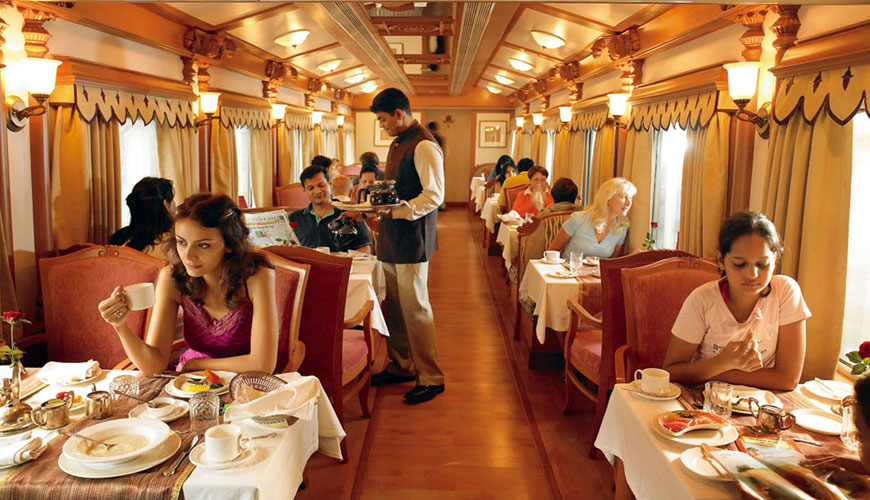
If you’re wondering what food on Indian luxury trains is really like, the short answer is: chef-crafted, regionally inspired, and surprisingly flexible to Western tastes and special diets. Onboard India’s top luxury trains, you’ll eat in elegant dining cars, sample flavours from every region you travel through, and still find familiar options if you prefer milder, global dishes. Most journeys run 3–7 nights between October and April, and Indian Luxury Trains (ILT) acts as your specialist planner, matching you to the right train, route and menus—and coordinating dietary needs with the train operators in advance.
Quick Facts
| Train | Main Route Focus | Typical Duration | Regional Flavour Highlights | Best Season |
|---|---|---|---|---|
| Maharajas’ Express | North & Central India (Delhi, Agra, Jaipur, Varanasi, Mumbai – route varies by circuit) | 3–7 nights | Mewar cuisine, Rajasthani thalis, Delhi & Mumbai favourites + global menus | Oct–Apr |
| Palace on Wheels | Classic Rajasthan loop + Agra (Taj Mahal) | 7 nights | Rajasthani & Mughlai dishes, plus Continental & Chinese options | Sept–Apr |
| Deccan Odyssey | Maharashtra, Goa, Gujarat & Central India (routes vary by itinerary) | 7 nights | Maharashtrian plates, Goan seafood, Konkan flavours and multi-cuisine menus | Oct–Apr |
| Golden Chariot | South India (Karnataka, Tamil Nadu, Kerala & beyond) | 5–7 nights | South Indian vegetarian classics, coastal dishes, plus international options | Oct–Mar |
What makes food on Indian luxury trains so special?
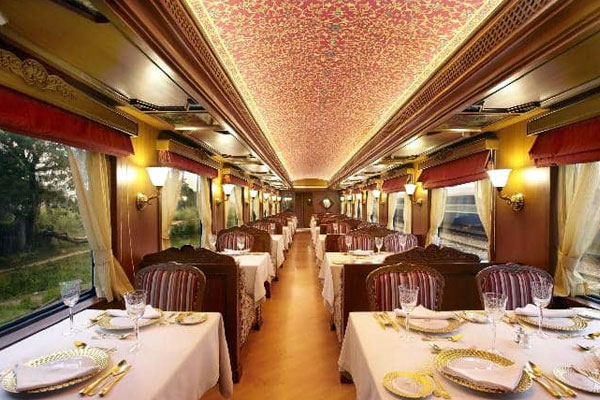
The key difference between Indian luxury trains and regular rail travel is that food isn’t an afterthought—it’s central to the experience. You’re not juggling plastic trays and station snacks; you’re sitting down to multi-course meals in ornate dining cars, with menus designed to mirror the regions outside your window.
Every luxury train featured on Indian Luxury Trains has:
- Two full-service restaurants, each with its own décor and ambience.
- Multi-cuisine menus: chef-driven Indian dishes plus Continental, Chinese and other global options.
- Fresh ingredients stocked en route, especially on itineraries where local markets and coastal stops supply seafood, fruits and vegetables.
- The ability to accommodate vegetarian, vegan, Jain and other special diets, provided they’re requested in advance.
Which Indian luxury trains offer the most interesting culinary routes?
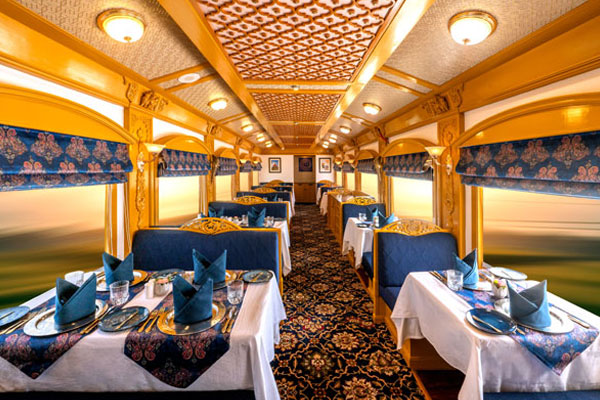
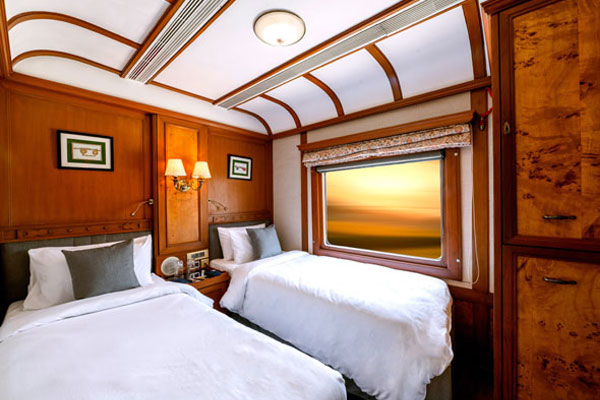
Each train has its own personality, both in décor and on the plate. The routes aren’t just geography; they’re moving food trails.
How does the Maharajas’ Express showcase India’s regional cuisines?
Maharajas’ Express runs four main circuits that take you through Delhi, Agra, Jaipur, Ranthambore, Varanasi, Mumbai and more, depending on the journey. On board, two fine-dining restaurants, Rang Mahal and Mayur Mahal, deliver an upscale experience with:
- Mewar-inspired dishes (think slow-cooked meats, local grains, and milk-based desserts).
- Regional thalis from Rajasthan and Punjab.
- North Indian staples like butter chicken, dal makhani and paneer dishes for comfort.
- European-style mains, salads and pastas for guests who prefer familiar flavours.
Menus are plated restaurant-style, not buffet. You can dine in one restaurant one night and the other the next, with servers learning your preferences as the journey progresses.
How does Palace on Wheels bring Rajasthani flavours to your table?
Palace on Wheels is the original Indian luxury train, doing a 7-night loop through Rajasthan and the Taj Mahal.
It’s two restaurants, Maharaja and Maharani, lean heavily into:
- Rajasthani dishes: Dal Baati Churma, Gatte ki Sabzi, and Laal Maas.
- Mughlai and North Indian gravies, kebabs and breads.
- Continental & Chinese options so guests can alternate between heavy Indian meals and lighter plates.
Menus change daily over the 7-night journey, so you’re not repeating plates, and desserts range from Indian classics (gulab jamun, rasmalai) to simple Western puddings.
What cuisines can you expect on the Deccan Odyssey?
Deccan Odyssey focuses on Maharashtra, Goa, Gujarat and Central India, so the menus reflect more Konkan and coastal flavours alongside pan-Indian classics.
In restaurants Peshwa I and Peshwa II, you’ll typically find:
- Breakfast menus with Indian and Continental options.
- Lunch and dinner menus rotate daily, including local fish curries, Goan-style dishes, and tandoor items.
- A dedicated Beverage & Wine menu featuring international spirits and wines (billed separately) plus complimentary water, juices and soft drinks.
What does dining look like on the Golden Chariot?
The Golden Chariot runs in South India, through Karnataka, Tamil Nadu and Kerala, depending on the chosen itinerary.
Its two restaurants, often referred to as Nalapaka and Ruchi, are known for:
- South Indian vegetarian spreads, including dosas, idlis, vadas and thalis.
- Regional dishes inspired by Mysore, Hampi and coastal Karnataka.
- A parallel line-up of international dishes, allowing you to moderate spice and richness.
When is the best time to enjoy food on Indian luxury trains?
Most Indian luxury trains operate primarily from October to April, when the weather is cooler and more comfortable for sightseeing and heavy meals.
- October–November: Post-monsoon freshness, cooler evenings; great for hearty regional dishes.
- December–January: Peak season; menus may feature more warming curries, rich gravies and desserts.
- February–March: Pleasant temperatures; arguably the sweet spot for both sightseeing and appetite.
- April: Warmer days; lighter menus, more salads and chilled desserts.
How do you actually reach and board these luxury trains for your culinary journey?
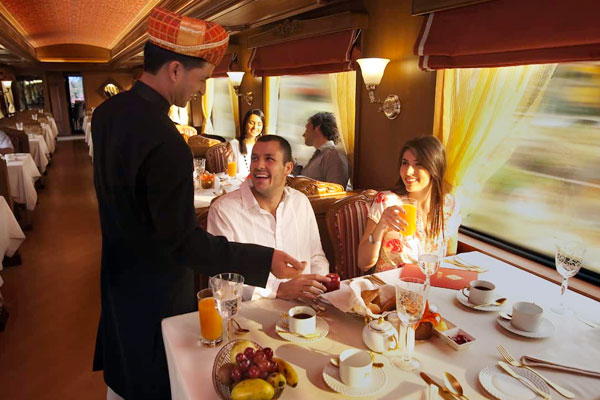
You’ll typically arrive by air into one of three main gateways: Delhi, Mumbai or Bengaluru, depending on your train:
- Maharajas’ Express – most circuits start/end in Delhi or Mumbai.
- Palace on Wheels – operates out of Delhi for the Rajasthan loop.
- Deccan Odyssey – often begins and ends in Mumbai.
- Golden Chariot – typically starts/ends in Bengaluru.
ILT generally recommends:
- Arriving at least one night before your train to recover from jet lag.
- Staying in a good 4–5★ hotel; your ILT consultant can bundle this into your quote.
- Using private transfers arranged by ILT between airport, hotel and train station to avoid local taxi friction.
What is a typical day of dining like on board?
On a representative Maharajas’ Express or Deccan Odyssey journey, a food-focused day might look like:
- 07:00–09:00 – Breakfast:
- A la carte plus small buffet: eggs cooked to order, pastries, cereal, fruit, dosas/poha/upma for those who want Indian breakfasts.
- 09:30–13:00 – Morning excursion:
- City tour, fort visit or game drive, with bottled water and sometimes snacks.
- 13:00–14:30 – Lunch on board:
- Three-course lunch with regional and global choices (e.g., thali vs grilled chicken with mash).
- 16:00–17:00 – High tea/snacks:
- Tea, coffee, savouries and sweets; sometimes served off-train at palaces or viewpoints.
- 19:30–21:30 – Dinner:
- Multi-course dinner in either restaurant, often themed by region visited that day.
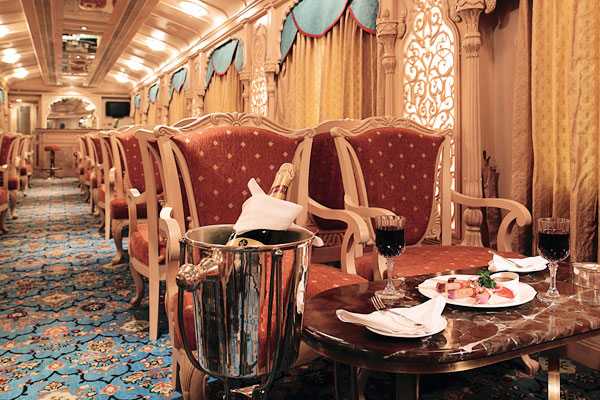
- After dinner – Bar/lounge:
- Coffee and digestifs; optional nightcap at the bar.
What kinds of regional dishes and menus will you taste onboard?
Expect a mix of regional Indian dishes and familiar comfort food:
North & West India – Rajasthani, Mughlai and royal cuisines
Trains like the Maharajas’ Express, Palace on Wheels and Deccan Odyssey highlight:
- Rajasthani thalis (dal, baati, churma, gatte, kadhi).
- Mewar dishes (steamed keema, traditional milk desserts, and slow-cooked vegetables).
- Mughlai gravies and kebabs.
- North Indian staples: paneer dishes, lentils, pulao, and naan/roti.
- Light Continental plates: grilled fish/chicken, steamed vegetables, pastas.
South Indian flavours – Golden Chariot and coastal influences
On the Golden Chariot and on Deccan Odyssey coastal routes:
- Breakfasts of idli, dosa, uttapam, and upma with chutneys and sambar.
- Coconut-based curries, seafood dishes, and tamarind-forward gravies.
- Rice-led meals and regional vegetable preparations.
Global comfort dishes for cautious palates
All major trains maintain a parallel line-up of Western dishes:
- Simple grilled meats or fish with potatoes and vegetables.
- Pastas, risottos, baked dishes.
- Clear soups, salads, sandwiches, and light desserts (sorbets, ice cream, and simple cakes).
The point is choice: you can go fully regional, entirely Western, or mix the two along the way.
How well do Indian luxury trains handle vegetarian, vegan, Jain and other dietary needs?
What special diets can be catered for?
Operators of trains like Maharajas’ Express explicitly note their ability to serve:
- Vegetarian and strict Jain meals (no root vegetables, onion or garlic).
- Vegan meals (no dairy, meat, eggs or animal products).
- Gluten-free menus.
- Lactose-free plates.
- Some Kosher-style meals (exact level of observance varies; true certified kosher is complex and must be checked individually).
- Low-spice or bland diets for medical reasons.
What they cannot realistically provide is a combination of extreme restrictions without prior planning (e.g., strict kosher + multiple allergies + no grains). That’s where ILT’s team will push back, clarify, or suggest alternatives.
How and when should you inform ILT about dietary restrictions?
Timeline that works:
- At the enquiry stage – mention vegetarian/vegan/Jain/gluten-free and any serious allergies.
- At booking – ILT records this in your file and with the operator.
- 30–45 days before departure – final confirmation of diets, spice level preferences and alcohol preferences.
- Onboarding day – your butler or restaurant manager will usually reconfirm your restrictions.
How do trains manage spice levels and “Delhi belly” worries?
Most Indian luxury trains are very experienced with older Western travellers and set spice levels accordingly:
- Dishes for foreign guests are typically medium to mild by default, with spicier condiments on the side.
- Drinking water is bottled/filtered; ice is usually made from purified water.
- Kitchen hygiene follows hotel-style standards; ingredients are washed with safe water and cooked thoroughly.
Simple steps ILT usually suggests:
- Stick to the train’s food and vetted off-train banquets.
- Use hand sanitiser before meals.
- Avoid raw street food in free time, especially early in the trip.
- Carry basic stomach medication approved by your doctor.
Are drinks and alcohol included on Indian luxury trains?
- Meals, tea, coffee, and most soft drinks are included on all trains.
- Alcohol (wines, beer, and spirits) is usually billed separately, except on some premium inclusions where “house pours” may be covered.
This varies by:
- Train (Maharajas’ Express vs Palace on Wheels vs Deccan Odyssey vs Golden Chariot).
- Cabin category and promotion.
- State alcohol laws and dry days.
What off-train culinary experiences are part of the journey?
Luxury trains don’t just feed you on board; many itineraries include special meals off the train, such as:
- Royal banquets in palaces or heritage hotels in Rajasthan.
- Themed village lunches or folk-dance evenings with local food.
- Sundowners in desert or riverside settings with snacks and drinks.
- Special dinners after game drives or Ganges ceremonies.
ILT can confirm which experiences are part of your specific departure and where menus may differ from onboard offerings.
How long should your culinary rail journey be, and who is it best for?
- 3–4 nights (e.g., short Maharajas’ Express circuits) – good if you’re time-poor or combining with a more extended land tour.
- 7 nights (Maharajas’ Express, Palace on Wheels, Deccan Odyssey, Golden Chariot variants) – the sweet spot for a proper tasting tour of multiple regions.
Who it suits:
- USA/UK/Aus/Canada retirees: best match—slow travel, comfort, all-inclusive, plenty of staff support.
- Couples & honeymooners: romantic setting, especially on Maharajas’ Express and Palace on Wheels.
- Families with teens: workable if teens can handle dress codes and structured meal times; ILT can advise on fit.
What local tips, etiquette and safety practices should you follow around food?
- Smart-casual attire is standard in dining cars; formal wear appears for special dinners but isn’t mandatory.
- It’s fine to take discreet photos of your table and food; avoid intrusive shots of other guests.
- Tipping guidelines vary; ILT normally provides a simple tipping sheet for train staff and excursion guides.
- Be cautious with unfiltered water, ice from uncertain sources and raw street food on free afternoons.
How to book and customise your menus with Indian Luxury Trains
Booking through ILT rather than directly through rail operators or generic OTAs gives you:
- A single expert point of contact familiar with all major trains, routes and dining quirks.
- One quotation covering trains, city stays, transfers and selected off-train dining.
- Proactively communicate dietary needs and special occasions to the operator.
- Support if anything needs adjusting mid-journey.

Comment (0)